Today’s edition of "O Liberal" had some interesting stories worth brief commentaries.
The telenovela* América ends today. Basically, the series covers the life of an illegal immigrant to Miami who gets deported back to Brazil. I don’t have a TV and have only seen portions of a few episodes, so I can’t vouch for the quality of the program. América is very popular here and people say that it is good.
Speaking of deportation, there was also a story about the third plane load of illegal immigrants being shipped back to Brazil, this time departing from Texas. Many of the illegal immigrants to the U.S. from Brazil come from the southeastern state of Minas Gerais. The state has paid for the entire cost of the flights, and the governor of Minas is complaining that it is not fair for his state to have to pay for the flights when they contain residents of other Brazilian states. He is also concerned about the image of Minas. He proposes that the federal government share in the costs of the flights and that the flights stop in various Brazilian state capitals. Minas Gerais is one of the richest states in Brazil.
Some people have asked about the drought in the Amazon. Most of the stories in the international press have been about Peru, although Brazil is also affected by what is said to be the Amazon's worst drought in 40 years. A story in today's paper focused on the problems communities near Santarém are having problems with transportation, potable water, and the spread of disease. It hasn’t rained much Belém, but the water level is normal. I plan to investigate the effects of the drought with a visit to the Santarém region in a few weeks.
Belém was rated by the Fundação Getúlio Vargas as the second worst place to live among Brazilian capitals, bested only by Rio Branco, the capital of Acre state in the western Amazon. According to the study, Belém’s biggest problems are violence, vandalism, and lack of adequate sanitation. Brasília, the federal capital, has the best quality of life.
And for some levity, one letter to the editor complained about the ever-earlier Christmas decorations that are starting to pop up all over Belém. It isn’t even Halloween, but I guess Brazilians can’t jump the gun on Thanksgiving. Yamada, which is basically Wal-Mart, has gigantic plastic Santas outside of one of its stores. I’ll try to remember to take some photos.
*A telenovela is like a soap opera that runs every night of the week for 3 – 4 months and then ends.
Friday, October 28, 2005

Wednesday, October 26, 2005
Sorvetology, part 3
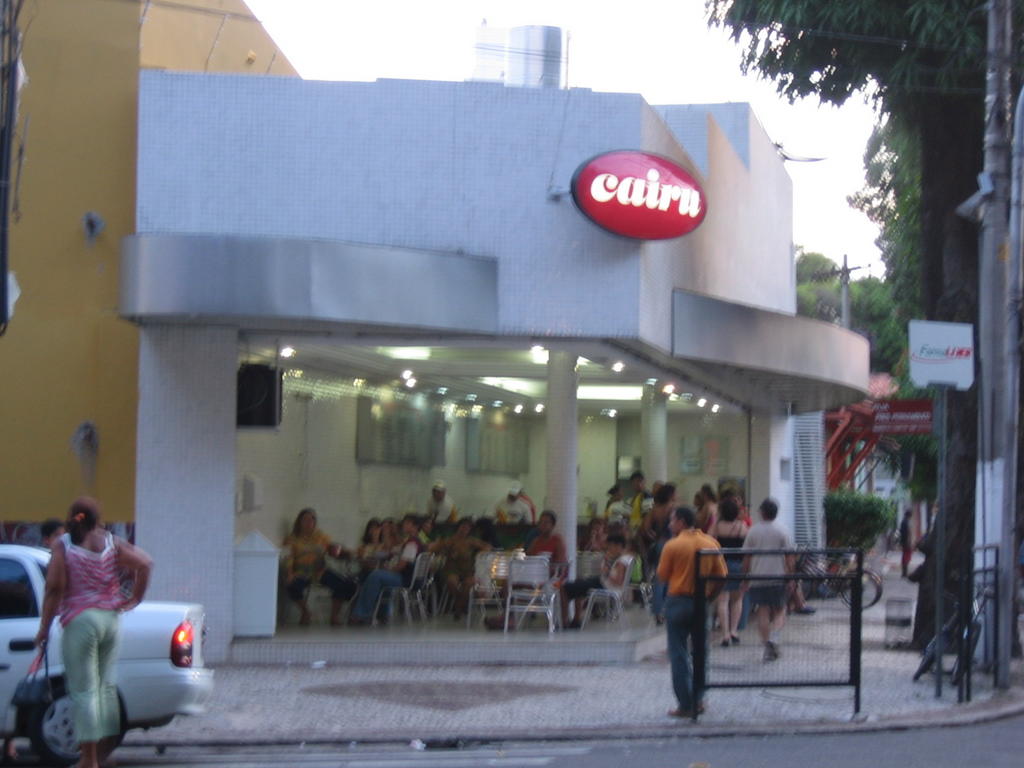 The Cairú store on Avenida Conselheiros Furtado in Batista Campos
Banana carmelada: carmelized banana.
Sonho de Valsa: milk chocolate with chips of chocolate covered cookie wafers.
Ki-passas: coconut icecream with raisins.
Goiaba: guava.
Uxí: no translation. I think this is a nut. The ice cream is light brown w/ darker brown flecks and reminds of peanut, but there is an interesting spicy kick as well.
Tuesday, October 25, 2005
Back in Belém
DC was good. The interview went well and I got to see some friends and family along the way. Still, getting there was a major pain in the ass since I spent 30 hours in flight, excluding airport time, and was on a plane every day for the past five days for at least two hours. On top of that, I had to change 5 of the 6 legs of the trip due to an initial scheduling problem and the hurricane. I really don’t understand why airlines don’t allow passengers, especially those without checked luggage, to parachute out as the plane flies over their final destination. That would have saved 10 hours today.
Thursday, October 20, 2005
Piles of Fruit
I've had an expensive, annoying day, spending about US$40 on phone calls trying to correct a flight that arrives after my interview is supposed to begin. Way to proof read, schedulers! And I still managed to go to class. But all should be good, provided that something totally off the wall like a hurricane hitting Miami doesn't happen. For serenity now, here are some pretty pictures of piles of food:
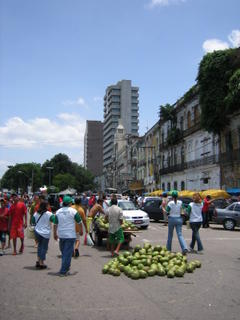

Piles of coconuts for agua de coco - R$1 each

Piles of pineapples - R$1.50 each.
Tuesday, October 18, 2005
Gas prices
Based on an unrepresentative survey of Belém's gas stations involving a sample size of one (the Shell station closest to my house), gas in Brazil costs R$2.69 a liter. With 3.8 liters to the gallon and 2.24 reais to the dollar, that comes to US$4.56/gallon. Brazil also sells alcohol, a blend of gas and fuel made from sugar cane, for R$2.09 a liter, or US$3.55/gallon. Almost all fuel stations sell both regular gasoline and alcohol, and most cars can run on both fuels.
In other car news, I rented out my apartment's parking space to a neighbor.
In other car news, I rented out my apartment's parking space to a neighbor.
Sunday, October 16, 2005
Forest mythology
After binging at an all-you-can-eat breakfast buffet, I went to central Belém’s largest park, the Bosque Rodrigues Alves. The park is a fragment of rainforest that was set aside in the late 1800’s when Belém’s political leadership was trying to create a Paris of the tropics, complete with its own Bois Boulogne.* The fragment is definitely a fragment – the park only covers about two city blocks – but has nice trails and is a good place to enjoy an afternoon if you can tune out bratty children. The most interesting things in the park were the two statues depicting creatures from Amazon Indian mythology.
The iara is basically a Siren of the rainforest: beautiful woman, irresistible voice, hangs out by waterfalls and lures Indians to their death. This one was perched by a little lake on which children take canoe rides:
The iara is basically a Siren of the rainforest: beautiful woman, irresistible voice, hangs out by waterfalls and lures Indians to their death. This one was perched by a little lake on which children take canoe rides:

Iara
The curupira is a little more imaginative. This forest creature can become invisible and has feet that point backwards. I’m not sure how much of this is re-envisioned environmental mumbo jumbo, but the plaque said the curupira protects regular forest dwellers so long as they only hunt for food and use forest resources for what they need. If the Indian uses the forest in an unsustainable manner, the curupira becomes his enemy and can make him get lost in the forest, always coming back to the starting point.

Curupira
I wonder what the curupiras are doing about the topic raised in this article in today’s “New York Times.” The article is about illegal logging in the Amazon, and all of the places mentioned are in the state of Pará. One thing I’m working on at my internship is alternative sanctions to environmental crimes since the penalties established in the laws don’t work. With the drought in the Amazon and the dry season just beginning, this is certain to be a very bad year for logging and forest fires.
Get busy, little curupiras.
*This isn’t as far-fetched as it sounds. For most of the 1800’s, Brazil had a monopoly on the production of rubber, which was in great demand during the Industrial Revolution. Because of the rubber trade, Belém and Manaus became fabulously wealthy.
Saturday, October 15, 2005
Alcatraz on the Amazon
Last night I went to one of the islands in the Rio Guamá. The organizers for the excursion only run the tour twice a year, and this was the fourth time they had gone. The cruise and island visit was definitely aimed at tourists, although I was the only non-Brazilian and it seemed like almost everyone else in the group of 30 or so was from Belém.
The boat left around 7:30 and cruised for about 20 minutes before entering an igarapé, or a channel that runs between river islands. The music on the way was good. After passing the homes of several ribeirinhos, the name for people who live on the islands and along the river, the group got out and encountered a gigantic canoe filled with fruit.
The boat left around 7:30 and cruised for about 20 minutes before entering an igarapé, or a channel that runs between river islands. The music on the way was good. After passing the homes of several ribeirinhos, the name for people who live on the islands and along the river, the group got out and encountered a gigantic canoe filled with fruit.

Annoying lady with microphone next to the fruit canoe
I pigged out on bananas, watermelon, cashew fruit, star fruit, acerola (red, tiny, and tart), papaya, and cacao (from which chocolate is made).
I also helped myself to some tacacá. Tacacá is an indian dish found all over Belém and is quite tasty. It is made from tucupi (lemony-tart juice of cassava) and is served with jambu (alkaloid spinach), and salty dried shrimp. It also has goma, which is made from finely ground cassava and has the consistency of snot. My first experience with tacacá was not very good as there was WAY too much goma in my serving, so I felt like I was drinking a bowl full of warm loogies. But this serving was more balanced and very enjoyable.

After the food, I could have left. Some people sang and dance around the campfire but I opted to stare at the almost full moon through the tree branches. The group of people I came with also wanted to leave, and by 10 we passed the time by making fun of the tour guide who would not leave the microphone alone. Finally, a little after midnight, we returned to Belém.
Subscribe to:
Posts (Atom)