Today was Nossa Senhora de Aparacida, a holiday honoring Brazil’s patron saint. The day is also referred to Children’s Day, a tradition that started in 1920. Nothing really special happened in Belém, especially since the city just binged on Círio festivities. There was a long line to get into the zoo and for some reason there was cake at the gym.
O Liberal, one of Belém’s daily newspapers, also had a report on child labor in the city. I forget the exact numbers, but it is estimated that there are almost 150,000 child laborers, or about a third of the city’s population of under 17 year olds. Most of these kids work on the street or as domestic servants.
Wednesday, October 12, 2005

Monday, October 10, 2005
Sorvetology, Part 2
My brain needs a break. The readings for tomorrow’s class were both in Spanish and I am trying to write the stupid reaction paper in Portuguese that basically says I did the reading. At least I’m brushing up on my Spanish/Portuguese false cognates.
With all the walking around the city I did during the holiday weekend, I passed many outlets of Cairú and continued my research into the ice cream chain’s unusual flavors. Since the last post on the same topic, I sampled the following flavors:
Tapioca: tasty but tame like the pudding.
Mestiço: açaí + tapioca.
Romeu e Julieta: cheesecake + guava jelly + flecks of cheddar cheese. The “Romeo and Juliet” is a popular food combination in Brazil. Pieces of white cheese with guava spread served as appetizers and a cheesecake both go by the same name.
Milho: corn. Not as bad as it sounds, but a little much for an entire scoop, especially when it could have been…
Carimbó: awesome. Cupuaçú + castanha do Pará (brazil nut). One of the best so far. Named for a regional music and dance.
With all the walking around the city I did during the holiday weekend, I passed many outlets of Cairú and continued my research into the ice cream chain’s unusual flavors. Since the last post on the same topic, I sampled the following flavors:
Tapioca: tasty but tame like the pudding.
Mestiço: açaí + tapioca.
Romeu e Julieta: cheesecake + guava jelly + flecks of cheddar cheese. The “Romeo and Juliet” is a popular food combination in Brazil. Pieces of white cheese with guava spread served as appetizers and a cheesecake both go by the same name.
Milho: corn. Not as bad as it sounds, but a little much for an entire scoop, especially when it could have been…
Carimbó: awesome. Cupuaçú + castanha do Pará (brazil nut). One of the best so far. Named for a regional music and dance.
Sunday, October 09, 2005
Círio Sunday
Today was the big day, where the relic was honored with yet another procession from the Catedral da Sé to the Basílica de Nazaré. The procession started at 7 AM but was too early for me so I didn’t show up until around 10.


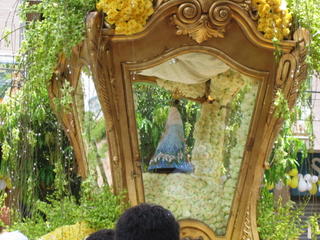 Our Lady of Nazaré
The procession was similar to the one on Saturday night except there were a lot more people. I heard estimates of two million floated but that seems too high and might have been a count for the entire weekend. Anyway, it doesn’t matter as Círio claims the title of Brazil’s largest religious procession without an apparent rival.
The other difference was that today some of the participants carried the wooden house, boats, and wax body parts mentioned in an earlier post. I didn’t see as many as I expected and there were more boats than anything else. Also, some of the houses were made out of Styrofoam, which I guess is a modern adaptation.
This guy was limping.
Posters calling for justice for Dorothy Stang, the murdered American nun
Another difference was that the corda was cut, which is sometimes done to protect both the people pulling it from being stampeded and the relic from toppling out of the carriage. When it is cut, people want a souvenir for what ever reason. There was a mini-mob trying to get a piece of the rope right where I was standing. I did my good deed for the day by picking up an about-to-be-smashed little girl and setting her on top of a drink cart.
Círio Saturday
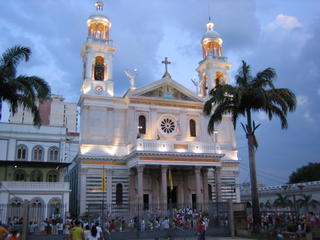
Basílica de Nazaré at dusk
On Saturday evening there was yet another procession, and this was the biggest one so far. The relic was moved from Colégio Gentil just east of the Basilica through the city to the Catedral da Sé, in the original part of the city. There were a couple hundred thousand people at this event, but the crowd was stretched out over almost 4 km so things did not get out of hand.
The new addition to this procession was the corda, which is basically a big rope that pulls the carriage holding the relic down the streets. The barefoot faithful* pull the corda along the route and try not to pass out or get smashed between the person on either side.

Photo of the crowd that shows the relic and a stretcher
This year, the procession from Colégio Gentil to Catedral da Sé took about five hours. Afterwards there was a big party called Festa de Chiquita in Praça da República.
*or, more accurately, the high school and college students who signed up because their friends did.
Saturday, October 08, 2005
Círio Effigies
Our Lady of Nazaré performs many miracles, and if you have a particular need you are supposed to accompany Sunday’s procession while carrying a representation of that need on your head. Need a house? Carry a small wooden house. People who are sick carry wax body parts in the hopes that they will be cured. Problem with your leg? Carry a wax leg, even if it hurts your real leg to spend eight hours pushing your way through a crowd of hundreds of thousands of people. Most body ailments are represented by a more generic head or body, so you don’t see people with leukemia carrying around wax white blood cells. Or maybe you do, but the cells are too small to be seen without a microscope.

street vendor selling wax effigies
The images have expanded into a cottage industry that makes brinquedos de miriti, brightly colored toys made out of balsa wood. I bought a little fish.

Processions a Plenty
Yesterday the relic of Our Lady of Nazaré was transferred from the basilica in Belém to the suburb of Ananindeua where she spent the night. I skipped the procession and mass during the heat of the afternoon and instead went to Auto do Círio, at night in Cidade Velha, the original part of the city. In the plaza between the old fort and the Catedral da Sé, various groups acted out the different stories associated with the legend of Círio and re-created the weekend’s events, such as the various processions and the carrying of the cord, which takes place on Sunday. The best I can describe the event is that it had a low-key Brazilian Carnivale atmosphere structured around passion journey plays. Like an idiot I forgot my camera, so I don’t have any photos of people in costumes. People participating in the plays wore all kinds of weird costumes, many seemingly unrelated to Círio. For example, one person dressed as a clown.
This morning there were more romariais, or processions. The relic moved from Ananindeua to the fluvial suburb of Icoaraci where it embarked on a big boat and sailed the ten nautical miles from Icoaraci to Belém. Accompanying the relic’s boat were some fifty large boats and maybe another fifty smaller boats, all decorated with balloons and flowers. I watched the arrival of the Romaria Fluvial (boat procession) from Estação das Docas, a redeveloped area of the port. A helicopter dumped rose petals before the relic disembarked.

This morning there were more romariais, or processions. The relic moved from Ananindeua to the fluvial suburb of Icoaraci where it embarked on a big boat and sailed the ten nautical miles from Icoaraci to Belém. Accompanying the relic’s boat were some fifty large boats and maybe another fifty smaller boats, all decorated with balloons and flowers. I watched the arrival of the Romaria Fluvial (boat procession) from Estação das Docas, a redeveloped area of the port. A helicopter dumped rose petals before the relic disembarked.

NS de Nazaré arriving on the big white ship. The relic is on a pedestal with yellow flowers.
After the Romaria Rluvial, the Romaria dos Motociclistas began. Along with hundred of people on motorcycles, the relic went up Avenida Nazaré, a major street of Belém, to Colégio Gentil, which is next to the basilica. Later this afternoon there will be yet another procession transferring the relic to Catedral da Sé.
Romaria dos Motociclistas
Thursday, October 06, 2005
Círio is in the air
Círio de Nazaré, Brazil’s biggest religious festival, is this coming weekend.* I’m very shaky on the details and symbolism, so I’ll refrain from posting much background except to say that the festival dates back to 1793 and has something to do with Our Lady of Nazaré, the patron saint of Pará, performing some miracle for a fisherman. People fly into Belém from all over Brazil, and more than a million people will flood the city streets on Sunday. Highlights of the festival include a procession from the docks to the the Catedral da Sé and then to the Basilica de Nazaré (about 10 blocks from my house), people engaged in a giant tug-of-rope (with Jesus?), and the slaughter of thousands upon thousands of ducks for the traditional dish of the festival, the extremely tasty pato no tucupi.
 Maratá coffee: strong like your faith
*Brief background information in English, although there are some inaccuracies like the size of the procession (i.e., hundreds of thousands, not thousands).

Doomed.
For Catholics in Belém, Círio is more important than Christmas. There are similarities between the two events. Lots of shops are decorated with images of the virgin of Nazaré, the guards at my apartment complex put out a little contribution box (I contributed), and people are running around in a frenzy buying things. Perhaps because of the frantic shopping or the sky-high price of duck, my laundry lady tried to charge me 50% more than usual for washing my clothes (I refused).
And, like Christmas, there is tacky commercialization, except here the religious imagery is more explicit. I took some photos of my favorite billboards around town:
Maratá coffee: strong like your faith 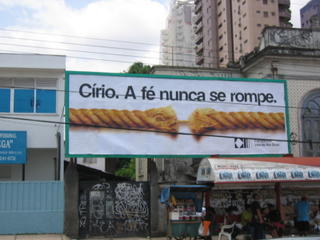
Círio. Faith never breaks.
(by Companhia do Vale do Rio Doce, a huge mining company)
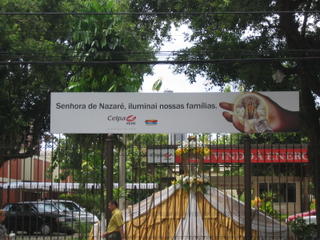
Our Lady of Nazaré, light up (enlighten) our families.
(by Celpa, the state electric company)
*Brief background information in English, although there are some inaccuracies like the size of the procession (i.e., hundreds of thousands, not thousands).
Subscribe to:
Posts (Atom)